
As a practical industry estimate, moving company net profit margins can fall roughly in the 4–12% range, although actual results vary significantly by business model, market, overhead, and service mix. IBISWorld tracks profitability for the moving services industry using EBIT rather than after-tax net income, so its figures are best used as a broader operating benchmark rather than a direct net-margin comparison. If yours sits below that, the cause is rarely pricing alone – it’s cost leakage, inconsistent operations, and revenue left on the table. This guide covers what a healthy margin looks like by business model, how to calculate yours, what quietly erodes it, and the levers that improve it without cutting rates.
Margin is the number that decides whether a busy season actually pays off. Two movers can book the same volume and end the year in completely different financial shape, because the moving company’s profit margin — not revenue — is what the business keeps. Understanding where yours should sit, and where it leaks, is the first step to improving it.
What is a good profit margin for a moving company?
Moving company margins vary considerably by business model, market, fleet structure, labor costs, and mix of local versus long-distance work. As a practical industry estimate, net margins often fall in the 4–12% range, while established local operators may perform above or below that range depending on how efficiently they price and run each job.
For a broader industry benchmark, IBISWorld’s Moving Services in the US report tracks profitability and cost structure for NAICS 48421. It is worth noting that IBISWorld defines its profit measure as earnings before interest and taxes (EBIT) rather than after-tax net income, so its benchmark should not be treated as directly interchangeable with a company’s net profit margin.
| Business model | Estimated gross margin | Estimated net margin |
|---|---|---|
| Local residential (asset-based) |
|
|
| Long-distance / van line |
|
|
| Non-asset brokerage |
|
The ranges above are practical industry estimates rather than fixed benchmarks, and individual companies may perform well above or below them.
How do you calculate your moving company’s profit margin?
Profit margin is profit divided by revenue, expressed as a percentage — but two versions tell you different things, and you need both.
Gross profit margin measures how profitable each job is before overhead: revenue minus direct job costs, divided by revenue. Direct job costs are the crew wages, fuel, truck use, and materials for that move. Net profit margin measures what the business actually keeps after everything: net profit divided by revenue, with overhead like office staff, marketing, insurance, and software included.
A worked example makes it concrete. A mover doing $1,000,000 in annual revenue with $700,000 in direct job costs has a 30% gross margin. After $220,000 in overhead, net profit is $80,000 — an 8% net margin. Tracking both numbers tells you whether a margin problem lives on the truck or in the office, which decides where to fix it.

What raises or lowers a moving company’s margin?
Labor is typically one of a moving company’s largest direct costs, so crew efficiency and scheduling have an outsized effect on what you keep. Fuel is among the most volatile costs, which is why static pricing set months ago can quietly erode margin when prices rise. After those, the biggest silent drain is rework and claims — damaged items, missed charges, and disputes that turn a profitable job into a loss.
None of these are fixed. Consistent estimating, organized dispatch that gets more out of every crew hour, disciplined pricing that keeps pace with fuel, and tight claims handling protect margin far more reliably than cutting rates ever will.
How to improve your moving company’s profit margin
Improving margin is less about one big move and more about closing small gaps across the operation. Four areas return the most.
Track every expense against the job
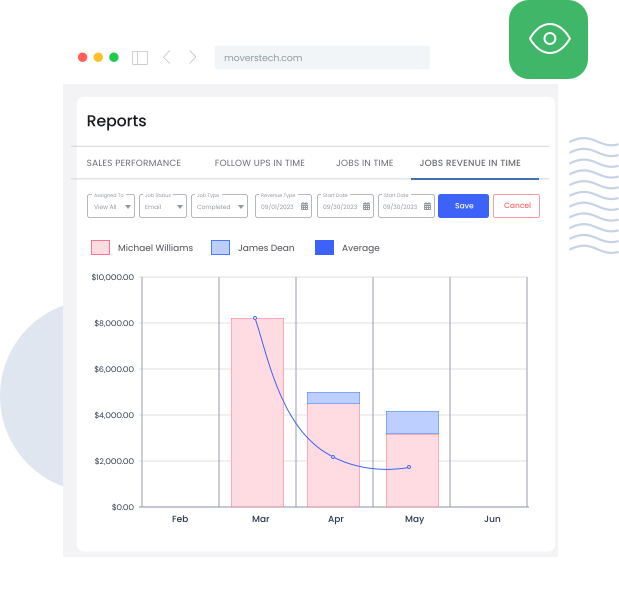
You cannot fix a margin you cannot see. When fuel, labor, and materials are tracked per job rather than as monthly lump sums, the jobs and routes that lose money become obvious. Real-time reporting turns a vague sense that “margins are tight” into a specific list of where the money goes.
Increase revenue per move
The fastest margin gains often come from earning more on moves you’re already doing — presenting valuation coverage as a real choice, offering packing and storage add-ons, and pricing accurately instead of underquoting to win the job. Each of these lifts revenue without adding a single new lead.
Improve operational efficiency
Because labor is the highest cost, efficiency is the highest-leverage improvement available. Tighter scheduling, cleaner dispatch, and automating repetitive admin work get more completed jobs out of the same crew hours and office staff — which flows straight to net margin.
Invest smartly instead of cutting back
When margins tighten, the instinct is to cut. But cutting service or staff usually costs more in lost jobs and reviews than it saves. The stronger move is to invest in the systems that remove waste and capture revenue, so the business comes out of a slow stretch leaner rather than smaller.
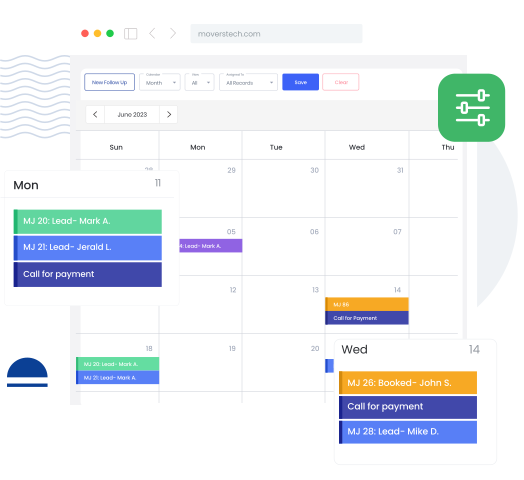
What makes these four levers work together is doing them in one place instead of across spreadsheets, notebooks, and separate apps. This is where a purpose-built moving CRM changes the math. With MoversTech, estimates and pricing are standardized so jobs aren’t underquoted, costs are logged against each job so unprofitable routes surface in your reports, dispatch and automation cut the manual hours that inflate labor cost, and add-ons like packing, storage, and valuation coverage are built into the booking so revenue per move rises without more leads. Instead of finding out a job lost money after the fact, you see margin taking shape while there’s still time to protect it.
Protect your moving company profit margin with MoversTech
A healthy moving company profit margin comes from seeing every cost clearly, earning more on each move, and running the operation without waste — not from cutting rates. MoversTech is an end-to-end CRM built for moving companies that brings estimating, dispatch, billing, and reporting into one system, so you can track margin by job, standardize pricing and add-ons, and cut the manual work that eats into profit. To see how it helps protect your margins as you grow, book a demo with MoversTech.
Frequently Asked Questions
What is the average profit margin for a moving company?

There is no single net profit margin that applies to every moving company. As a practical industry estimate, margins can fall roughly in the 4–12% range, but results vary considerably depending on labor, fuel, overhead, service mix, and whether the company focuses on local, long-distance, or brokerage work.
How do you calculate profit margin for a moving company?
Divide profit by revenue. For gross margin, use revenue minus direct job costs (crew, fuel, truck, materials) divided by revenue. For net margin, use net profit — after overhead like office staff, marketing, and insurance — divided by revenue.
Why is my moving company's profit margin so low?
Usually cost leakage rather than low prices: labor and fuel running high per job, underquoted moves, missed charges, and claims. Tracking costs per job and tightening dispatch and pricing typically recovers more margin than raising rates.
How can a moving company increase its profit margin?
Earn more on existing moves through add-ons and accurate pricing, improve crew and dispatch efficiency to lower labor cost per job, and track expenses per job so unprofitable routes are visible. These lift margin without needing more leads.
